When Power Clashes…
Khulan M.
March 16, 2026
March 16, 2026
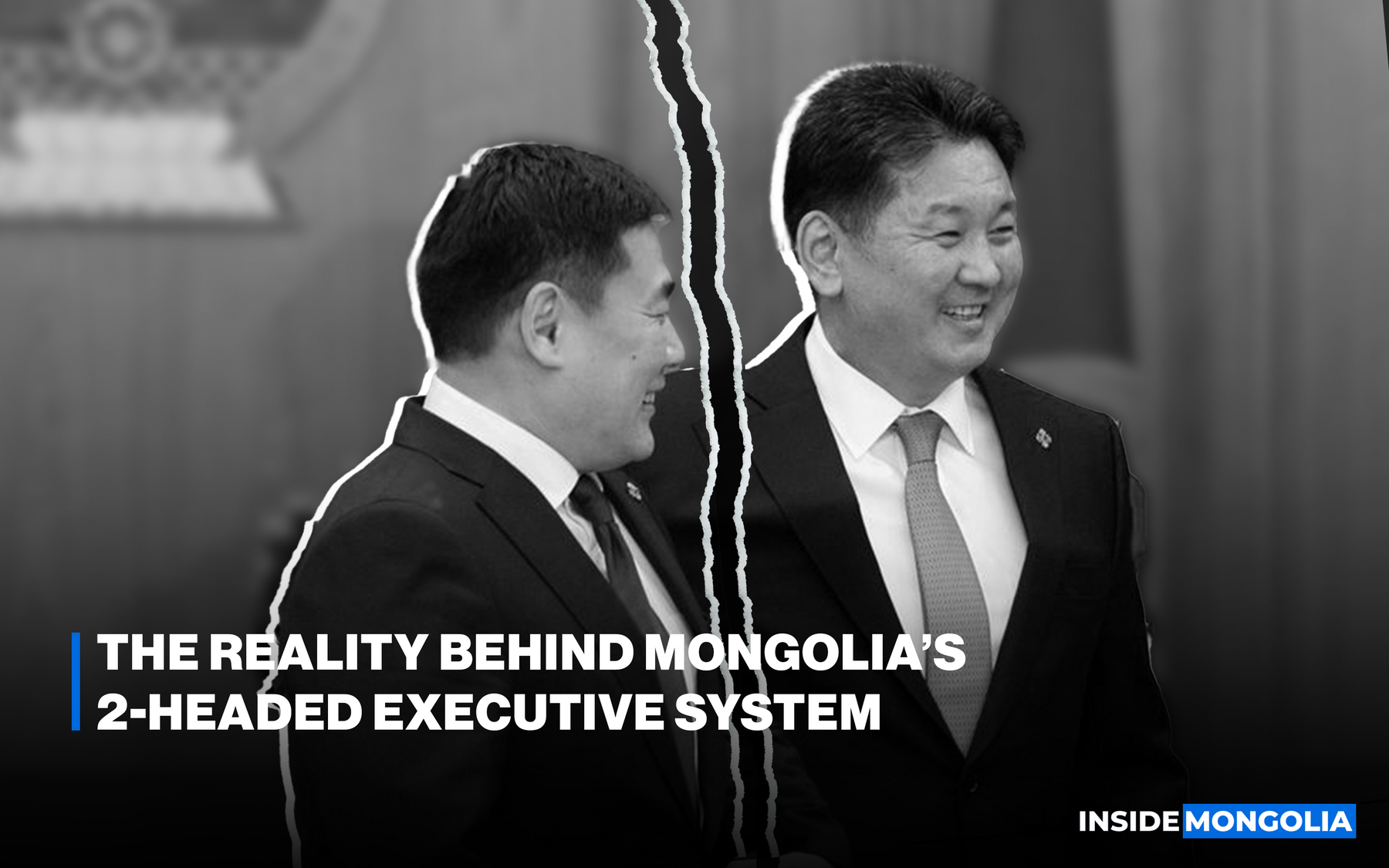
What is unfolding in Mongolian politics is the long-running reality of a 2-headed executive system, in which both the President and the Prime Minister (PM) carry competing political weight under the 1992 Constitution.
- 🎤 In his first public appearance since leaving office, ousted former PM L.Oyun-Erdene spoke about his fallout with the President, once his closest ally and key political backer, reflecting Mongolia’s long-running pattern of conflict between the presidency and the premiership.
🏃➡️ From President vs PM to President vs Parliament
The key highlight of the ex-PM’s interview was his argument that the main fault line is now shifting from President vs Prime Minister to President vs Parliament. As Mongolia moves closer to the 2027 presidential election, he argued, institutional pressure is intensifying. The ex-PM stressed that the President’s recent proposed draft law on the recall of Members of Parliament (MPs) is part of a broader effort to weaken Parliament’s independence and narrow the space for political competition ahead of the next electoral cycle.
- 🤒 In that framing, the issue is no longer only about who will control the presidency next, but whether Parliament can continue to function as a meaningful counterweight.
Another major theme was what could be called the MPP’s internal orchestration for the next presidency. Under the 2019 constitutional amendment, the President is elected for a single 6-year term. But according to the ex-PM, this is where his main conflict with President U.Khurelsukh began. He claimed the President was interested either in seeking another term through a fresh constitutional amendment or in returning to lead the MPP after leaving office.
💀 The “Tunnel” Concern
More concerning is the claim that both past and current Presidents have held the keys to the so-called “tunnel”, a system through which law enforcement and judicial processes can allegedly be influenced for political ends. In this telling, the “tunnel” functions as a tool of political engineering, especially ahead of major cycles such as the 2027 presidential election.
- 🔗 For instance, it can allegedly be used to sideline rivals by launching or reviving cases, while also pressuring Parliament through legal and “moral” investigations aimed at winning support for measures such as the recall initiative.
Perhaps that is also why the ousted PM suddenly found his voice after stepping down. He may fear that he himself could be dragged through the same tunnel system.
😵 The “vacuum” of power
Despite the constitutional requirement for the President to remain non-partisan, the ex-PM claims that the President’s office is effectively acting as the de facto leadership of the MPP. That, in turn, is creating friction with the party’s formal leadership as different factions position themselves for control over the 2027 political cycle.
Finally… Yes, the ousted PM was once seen as a political monster in his own right. But the system now on display may be far more dangerous than any one individual. Even when he held enormous power, he failed to carry out the meaningful reforms he is now criticizing. Even so, the broader point remains hard to ignore. Mongolia’s institutional sovereignty appears to be in crisis.
The core power-balancing institution, the judiciary, is claimed to be functioning like an authority’s magic wand. In a system skilled at mass manipulation, silencing those who challenge it becomes a direct threat to democracy’s survival. Unless that is exactly what people choose to tolerate.
Comment