Mongolians Celebrate 9 Public Holidays Annually

Khulan M.
November 25, 2024
November 25, 2024
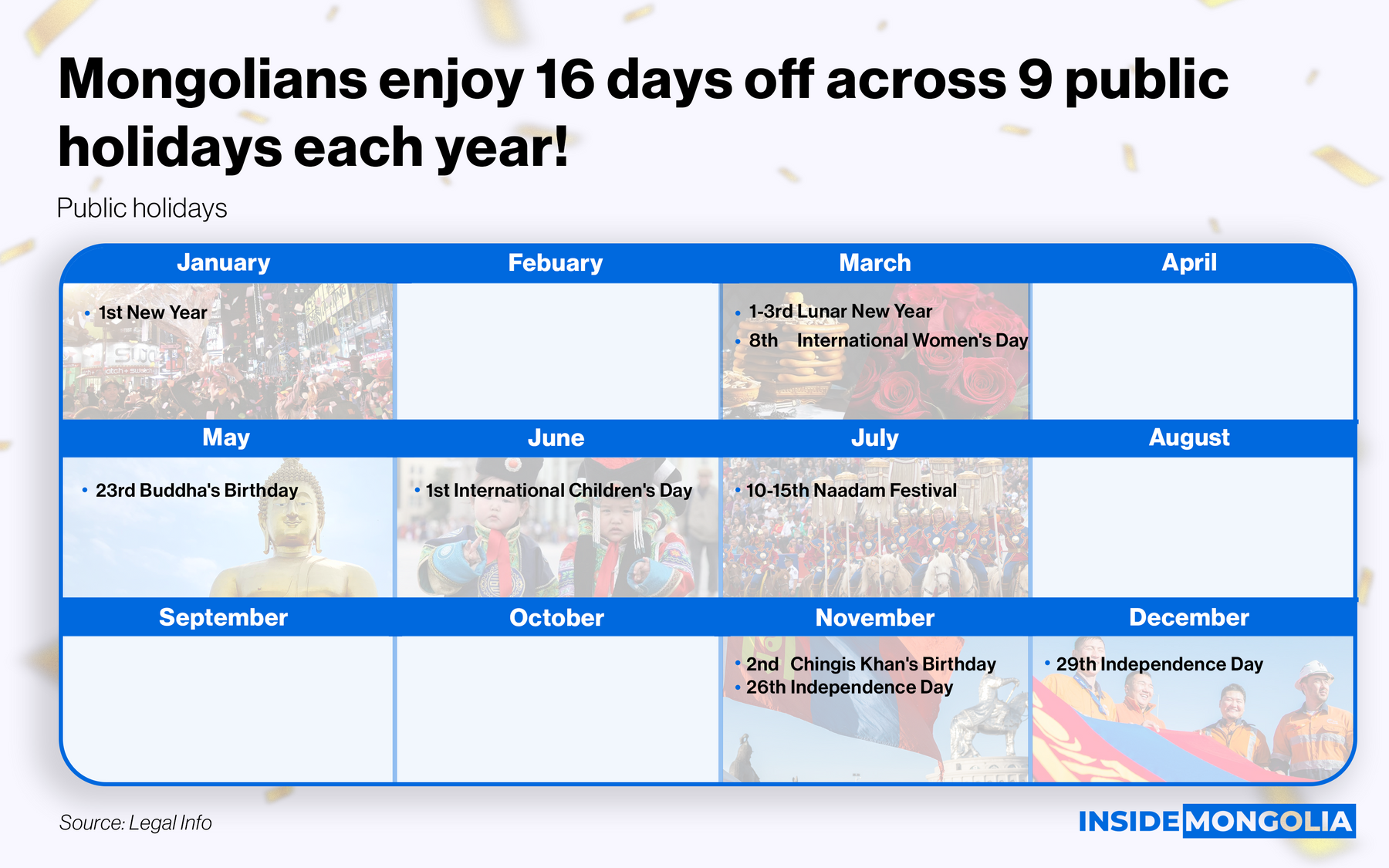
Tomorrow marks Mongolia’s Independence Day, one of the 9 public holidays the country enjoys each year. While we celebrate 16 public holidays in total annually, it is interesting to examine how Mongolia’s holiday calendar compares to those of other countries and how the number of public holidays affects national productivity.
Public Holidays 🆚 Productivity
Compared to other countries, Mongolia stands out for having a large number of public holidays. For example, Nepal celebrates 42 days of various holidays per year. Most of the countries with the highest number of public holidays are in Asia. Meanwhile, European countries tend to have fewer public holidays. Whereas in neighboring countries, China has 7 public holidays per year, while Russia has 8. Japan and South Korea celebrate 16 public holidays annually. In the United States, citizens observe 11 public holidays each year.
- 🔗 The relationship between public holidays and productivity reveals notable patterns. According to the International Labor Organization, Luxembourg, despite having 10 public holidays, leads in productivity with an hourly rate of $136. The United States ranks 6th with $63 per hour. In contrast, countries with a higher number of holidays often show lower productivity. For instance, Nepal, which has the most holidays, records a labor productivity rate of just $3 per hour. Mongolia, at $13.7 per hour, performs better than Nepal but falls behind more developed nations.
- 💭 Critical: An intriguing aspect of daily life is how citizens utilize their free time. Mongolians sleep an average of 9.5 hours daily, and education receives just 32 minutes, or 2.2% of their day. Of the 3.1 hours of free time, 51% is spent on social media, with the rest divided between sports, art, and social activities.
While holidays support work-life balance, they can also impact productivity. Countries like Luxembourg, with fewer public holidays, maintain high productivity, while countries with many holidays often face lower output. This raises the question “How can Mongolia balance the cultural importance of holidays with the need for higher productivity in its workforce”?
In recent years, many citizens have expressed concerns about the tendency to live from holiday to holiday, questioning whether they are contributing to economic challenges. Mongolia’s economy is heavily reliant on sectors like mining and agriculture, where consistent work is crucial. As the economy faces challenges, it’s essential to consider how national holidays impact overall economic growth and stability.
Comment