Business Freedom Law Headed for Fast-Track Approval

Khulan M.
June 8, 2026
June 8, 2026
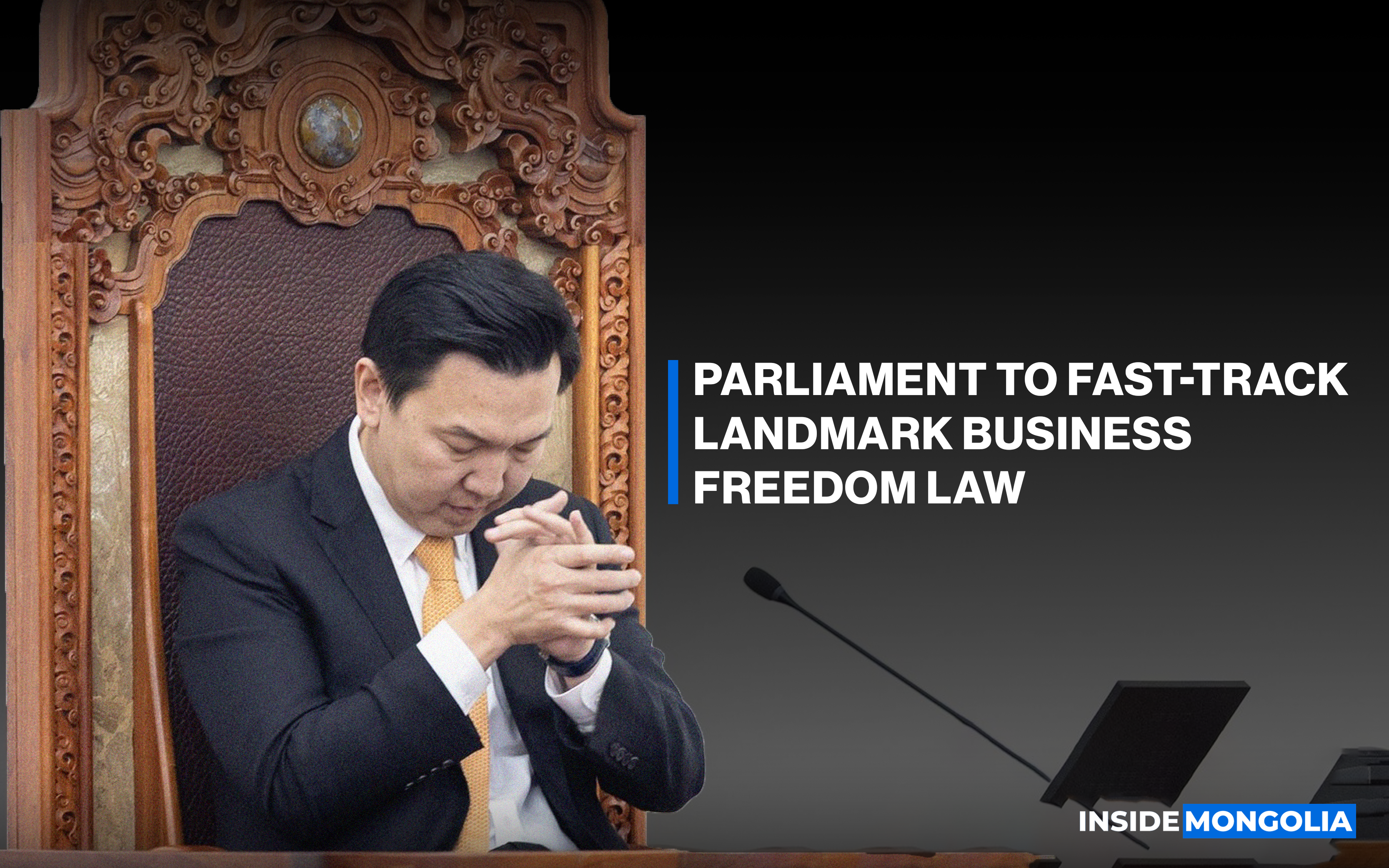
The Mongolian government has submitted a landmark draft law on Business Freedom, along with amendments to 99 related laws, to Parliament under an urgent procedure. The proposed legislation aims to simplify the licensing system, reduce government bureaucracy, improve the investment climate, and ensure greater tax stability for businesses.
🏋🏻♀️ Simplifying the Permit System
Under the new draft law, special permits for companies would be extended to 10 years, while standard permits would last 5 years. If authorities fail to respond to a standard permit application within 22 days, the permit would be considered automatically approved, allowing businesses to begin operations without delay.
- 🏃🏻♂️ The draft also removes the current restriction that prevents businesses with tax or social insurance debts from obtaining permits. This change is expected to ease pressure on small and medium-sized enterprises.
✂️ Cutting Red Tape Across the Board
The legislation includes significant measures to reduce bureaucratic hurdles. Over 120 types of permits would be transferred to professional associations, while more than 30 permits would be fully eliminated. Additionally, 146 existing licensing requirements currently operating under the names of “registration” or “certificates” would be streamlined and clarified.
🤑 Supporting Investment and Long-Term Stability
To attract larger investments, the draft law introduces tax stabilization agreements for projects worth ₮50 billion or more, with stabilization periods of up to 20 years. It also establishes mechanisms for resolving investor disputes through arbitration and mediation, offering greater legal certainty for both domestic and foreign investors.
🧩 Boosting Green Economy and Technology
The proposed law includes strong incentives for Mongolia’s green and digital transition. Imports of equipment related to renewable energy, battery storage, green hydrogen, data centers, and artificial intelligence would be fully exempt from customs duties.
In addition, the draft introduces a legal framework for conducting government procurement through AI-based, fully automated systems with minimal human intervention, a significant step toward modernizing public services.
- 📃 Expected Impact: According to the government, these reforms will reduce administrative barriers, improve the quality of public services, and create a more favorable environment for investment, job creation, and sustainable economic growth.
Overall… the Business Freedom draft law is one of the most ambitious efforts in recent years to modernize Mongolia’s business environment and improve its investor appeal, though its real impact remains uncertain given past gaps in implementation and limited progress in reducing regulatory burdens.
Comment